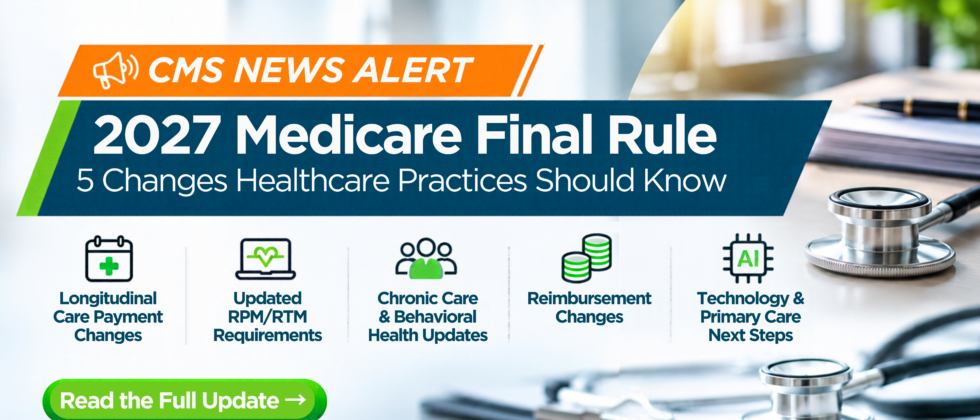
From physician reimbursement to remote monitoring, here’s what the latest CMS changes mean for practices preparing for 2027.
The Centers for Medicare & Medicaid Services (CMS) released the 2027 Medicare Physician Fee Schedule Final Rule on November 4, 2026, introducing changes that will influence reimbursement, care delivery, and practice operations.
While some changes take effect January 1, 2027, others provide a longer window for preparation.
Here are five developments practice leaders should know—and why they matter.
- Greater Recognition of Longitudinal Care
CMS is changing how Medicare recognizes the resources required to support patients over time.
Beginning in 2027, the existing G2211 visit complexity add-on will transition to a new modifier, B1, increasing payment for qualifying evaluation and management (E/M) visits by 16%.
CMS also finalized a 32% payment increase through modifier B2 for eligible E/M visits furnished by qualifying practitioners participating in Medicare Shared Savings Program ACOs or the LEAD Model.
Why it matters: These changes reinforce the importance of ongoing patient relationships and coordinated care. For practices and ACOs, they also strengthen the business case for investing in infrastructure that supports patients beyond individual appointments.
These increases apply to eligible E/M visits, not directly to CCM or PCM reimbursement.
- New Requirements for Remote Monitoring
CMS finalized several changes to Remote Physiologic Monitoring (RPM) and Remote Therapeutic Monitoring (RTM).
Beginning in 2027:
- RTM services must be furnished to established patients.
- Practitioners must furnish a separately reportable initiating visit when starting RPM or RTM services.
- Payment valuations for remote monitoring services will change.
CMS also finalized restrictions on using contracted clinical staff to furnish RPM/RTM services, but delayed implementation until January 1, 2029.
Why it matters: Practices should review their remote monitoring workflows, staffing arrangements, and vendor relationships now. The delayed restriction provides time to evaluate how programs can remain compliant and sustainable.
- Continued Focus on Chronic Disease and Behavioral Health
CMS continues to prioritize chronic disease prevention and management, including approaches that support patients with complex, ongoing needs.
The final rule establishes separate payment for shared medical appointments and updates payment valuations for services under the Psychiatric Collaborative Care Model.
These developments reflect continued recognition of multidisciplinary care, patient engagement, and coordinated support.
Why it matters: Managing chronic conditions requires more than periodic office visits. Practices need effective ways to reinforce care plans, support healthier behaviors, and identify patient needs between appointments.
This is an opportunity to evaluate whether existing care management programs are reaching patients consistently and providing meaningful support throughout their care journey.
- Physician Reimbursement Remains Under Pressure
The final rule includes decreases to Medicare’s physician payment conversion factors compared with 2026.
For 2027, CMS projects:
- 1.83% decrease for qualifying Advanced Alternative Payment Model participants.
- 2.31% decrease for nonqualifying practitioners.
Actual reimbursement impacts will vary by specialty and service.
Why it matters: With ongoing financial and staffing pressures, practices must find ways to improve patient support while managing operational costs.
Programs that expand care team capacity, improve patient engagement, and reduce administrative burden can play an important role in a sustainable care delivery strategy.
- Technology-Enabled Primary Care Remains an Area to Watch
CMS continues to explore how technology and alternative payment approaches could better support preventive and ongoing primary care.
Although the final rule does not establish a broad new payment model for technology-enabled primary care, CMS reviewed feedback on technology’s role in care delivery and potential prospective payment approaches.
Why it matters: Technology can help practices connect with more patients, streamline communication, and improve care coordination.
But technology alone isn’t the answer. Its value comes from supporting clinical teams, strengthening patient relationships, and making care delivery more efficient.
What Should Practices Do Next?
The 2027 Final Rule is an opportunity to assess whether current care management programs are positioned for what’s ahead.
Three priorities deserve attention:
- Review program performance. Are your care management programs effectively enrolling, engaging, and supporting patients?
- Evaluate operational readiness. Are your remote monitoring workflows, staffing models, and compliance processes aligned with evolving requirements?
- Plan for sustainable growth. Can your programs expand to support more patients without increasing the burden on internal teams?
Building for Today. Ready for What’s Next.
Medicare’s evolving policies reinforce the importance of coordinated, longitudinal care—and the need for practices to adapt as healthcare changes.
At Cosán, we help healthcare organizations build and strengthen care management programs customized around their patient populations, operational needs, and long-term goals.
Better care. Built to scale.
Is Your Care Management Program Ready for What’s Next?
Whether you’re starting a program or looking to improve an existing one, Cosán can help you explore opportunities to strengthen patient engagement, expand capacity, and build a more sustainable care management strategy.
Source: CMS: CY 2027 Medicare Physician Fee Schedule Final Rule, November 4, 2026
This article is intended for general education and does not constitute legal, billing, or compliance advice.
